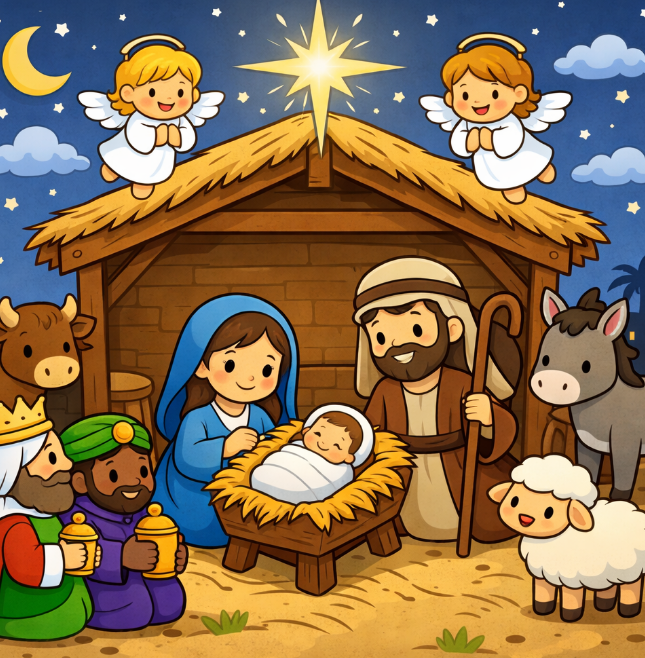
Christmas: The Mystery of God Made Flesh
The Great Mystery We Celebrate
At Christmas, the Church invites us to contemplate not merely a beautiful story, but a profound mystery of faith: God became man.
The Catechism of the Catholic Church names this mystery clearly:
“The Word became flesh for us in order to save us by reconciling us with God” (CCC 457).
Christmas is the feast of the Incarnation, when the eternal Son of God entered time, taking on human nature without ceasing to be divine.
“And the Word became flesh and dwelt among us” (John 1:14).
This single moment changes the course of history. God does not save us from a distance. He enters fully into the human condition.
A God Who Chooses Poverty and Humility
The birth of Christ takes place not in comfort, but in simplicity and vulnerability.
“She gave birth to her firstborn son… and laid him in a manger” (Luke 2:7).
The Catechism reflects on this choice:
“Jesus’ birth in Bethlehem reveals the humility of God” (CCC 525).
In the manger, we see a God who chooses poverty to draw close to the poor, the forgotten, and the lowly. This humility invites us to examine our own hearts. Christmas calls Catholics not only to rejoice, but to imitate Christ’s humility.
Mary, Mother of God
At the center of the Nativity stands Mary, who freely cooperates with God’s plan of salvation.
“Behold, I am the handmaid of the Lord. Let it be done to me according to your word” (Luke 1:38).
The Church honors Mary as Theotokos, Mother of God, because the child she bears is truly God incarnate (cf. CCC 495). Her yes makes Christmas possible.
Mary teaches us how to receive Christ: with trust, obedience, and surrender. As the Catechism reminds us:
“Mary is the perfect Orans (pray-er), a figure of the Church” (CCC 2679).
The Shepherds and the Universal Call to Salvation
The first witnesses to the Nativity are shepherds—ordinary people, living on the margins of society.
“I proclaim to you good news of great joy that will be for all the people” (Luke 2:10).
This moment reveals a core Catholic truth: salvation is universal. Christ is born not only for a few, but for all humanity.
“The Church is missionary by her very nature” (CCC 849).
Christmas reminds us that the joy we receive is meant to be shared.
Christmas and the Eucharist
Catholic tradition sees a deep connection between the manger and the altar. Jesus is laid in a manger—literally a feeding trough—foreshadowing the gift of Himself as spiritual nourishment.
“I am the living bread that came down from heaven” (John 6:51).
The Catechism teaches:
“The Eucharist is the source and summit of the Christian life” (CCC 1324).
At Christmas, we do not simply remember Christ’s birth—we encounter Him sacramentally in the Eucharist. The same Jesus born in Bethlehem comes to us today under the appearance of bread and wine.
The Nativity Points to the Cross
The wood of the manger quietly points toward the wood of the Cross. Christ is born in order to redeem.
“You shall call his name Jesus, for he will save his people from their sins” (Matthew 1:21).
The Incarnation is inseparable from the Paschal Mystery. As the Church teaches:
“The Son of God became man so that we might become God” (CCC 460).
Christmas is not sentimental. It is salvific.
Living Christmas as Catholics Today
The proper response to Christmas is not only celebration, but conversion.
Like Mary, we are called to say yes.
Like the shepherds, we are called to witness.
Like the Magi, we are called to adore.
“Let us go, then, to Bethlehem to see this thing that has taken place” (Luke 2:15).
Christmas invites us to slow down, to adore Christ in silence, and to carry Him into the world through acts of mercy, charity, and faithfulness.
A Christmas Prayer
Lord Jesus Christ,
born of the Virgin Mary,
make our hearts a dwelling place worthy of You.
May we receive You with humility, adore You with reverence,
and proclaim You with joy.
Amen.
Reflection Question:
How can you make room for Christ in your life this Christmas—not only in celebration, but in daily discipleship?